

How to Become an Occupational Therapist
A career as an occupational therapist (OT) means helping people improve their lives by making daily tasks easier and less painful. When you learn how to become an occupational therapist, you are learning how to have a fulfilling career that makes a difference.
What Does an Occupational Therapist Do?
What is an occupational therapist? According to the U.S. Bureau of Labor Statistics (BLS), occupational therapists “evaluate and treat people who have injuries, illnesses, or disabilities.” An occupational therapist works with clients and their care teams to help them live more independently by maintaining, improving, or learning new skills related to the activities of daily living.
OTs may evaluate patients and work with them to develop goals for their time with their therapists, create custom treatment plans, and continually evaluate and adjust those treatment plans to keep patients on track with their goals. Occupational therapists help their clients overcome physical as well as mental, emotional, and social challenges.
Education Requirements for Occupational Therapists
Occupational therapists must have a minimum of a master’s degree to earn licensure and work independently. To qualify for an OT master’s program, students must complete a bachelor’s degree. While a bachelor’s in occupational therapy is not necessary for admission to a master’s program, applicants should be sure that their undergraduate coursework includes occupational therapy prerequisites such as:
- Anatomy and Physiology I & II
- Psychology (General, Abnormal, Lifespan Development)
- Sociology/Anthropology
- Behavioral Statistics
A Master of Science (MS) degree typically takes full-time students two years to complete. Students in an early admission OT program may be able to earn both their bachelor's and master's degrees in as little as five years.
Why Choose Iona’s Occupational Therapy Program
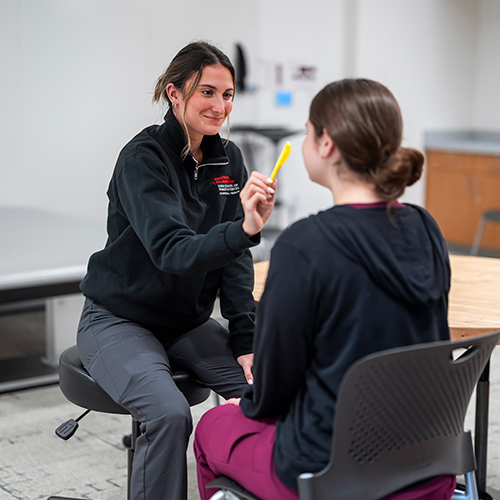
A master's degree in occupational therapy at Iona University is part of a program that leverages the talent and dedication of skilled faculty members who share their expertise along with the latest developments in occupational therapy. Iona OT students are given the tools to provide patients with exceptional care on their paths to healing and rehabilitation.
The Iona OT program includes campus partnerships with other programs in the health sciences, allowing students to benefit from a curriculum that extends beyond the classroom. Experiences in community engagement and service help students develop cultural competence, empathy, and the ability to work effectively with diverse populations — skills that are essential in occupational therapy, where treatment plans must be tailored to everyone's unique circumstances. By blending these elements with the rigors of occupational therapy coursework, Iona prepares graduates to be adaptable leaders who can meet challenges in both clinical and community-based settings.
The Iona graduate OT program is accredited by the Accreditation Council for Occupational Therapy Education (ACOTE) of the American Occupational Therapy Association (AOTA). Accreditation is essential for future OTs and their licensure prospects.
Career Outlook & Salary Expectations
The availability of occupational therapy graduate jobs is likely to increase in the coming years. According to the BLS, the demand for occupational therapists is expected to grow by 11% between 2023 and 2033, which is much faster than the average for all occupations. As the median age of the American population continues to increase, there is likely to be increased demand for OTs who can help older adults remain independent for as long as possible.
Across the U.S., the median pay for occupational therapists is $98,340 per year. The New York metropolitan area has the highest employment rate for OTs across all metro areas in the U.S., and New York state has the third highest rate of employment among states, with more than 10,500 employed OTs.
Approximately 29% of OTs work in hospitals, 28% work in private clinics, 13% work in educational settings, and the remainder are split between home healthcare services and nursing care facilities. Notably, those working for home healthcare services have the highest mean wage at $109,560.
Tips for Future Occupational Therapists
Future occupational therapists will benefit from adaptability and flexibility. New technologies, such as wearable smart watches and fitness trackers, are constantly being introduced into the OT field, which presents an opportunity for OTs who are willing to learn to use and calibrate these tools for their patients’ goals.
Occupational therapists are also professional communicators. OTs must be able to communicate with their patients as well as a network of care providers, from home healthcare workers to general practitioners, surgeons, nurses, oncologists, and family members. Aspiring OTs should focus on practicing their interpersonal communication skills whenever possible.
As in any healthcare profession, establishing strong boundaries is important for future OTs. Working closely with patients and their families can be both physically and emotionally draining. Finding time for self-care and learning how to leave work behind will be essential to flourishing in the career for the long term.
How to Apply to Iona’s Occupational Therapy Program
If you want to pursue a career that helps people live healthier, more fulfilling lives with less pain, occupational therapy may be the right choice for you. The Iona OT program offers master’s degree students a chance to work with experienced faculty in a passionate and committed cohort.
To apply for the Iona OT program, prospective students must submit their application through the Occupational Therapy Centralized Application Service (OTCAS), which requires a processing fee. In addition, applicants must:
- Complete a bachelor’s degree in any field from an accredited University
- Maintain an undergraduate GPA of at least 3.0
- Complete all prerequisite coursework
- Provide proof of at least 40 hours of volunteer or observational experience with either an occupational therapist or occupational therapy assistant prior to enrollment
Applicants to the OT program must interview with the faculty to complete the application process.
Ready to apply or want to learn more about our occupational therapy department?
FAQs
Occupational therapists must hold a master’s degree in occupational therapy in order to qualify for licensure and independent practice.
Most occupational therapy master’s degrees can be completed in two years. Prior to that, a bachelor’s degree typically takes four years to complete, making the total time it takes to become an occupational therapist five or six years, depending on the program.
Occupational therapy focuses on helping patients learn, maintain, or improve the skills that help them engage in meaningful activities, including caring for themselves and participating in work and hobbies. On the other hand, physical therapy focuses largely on recovering strength and mobility following an injury or illness. Both professions work closely with patients and care teams to meet patient goals, increase strength, and reduce pain.
Occupational therapy is a good career for someone who wants to dedicate themselves to helping others live full and independent lives. The demand for occupational therapists is expected to grow in the coming years, meaning there will be more job openings and potentially higher salaries in the coming decade.
The mean annual salary for occupational therapists in New York state is $98,980, while the hourly median wage is $45.85. Salaries can vary considerably between metropolitan regions, with OTs in the New York City area typically earning more than in other areas of the state.
No, you do not need a doctoral degree to become an occupational therapist.