

What will meaningful work look like in the AI age? David Autor, Ph.D., opens “Future of Work” conference at Iona
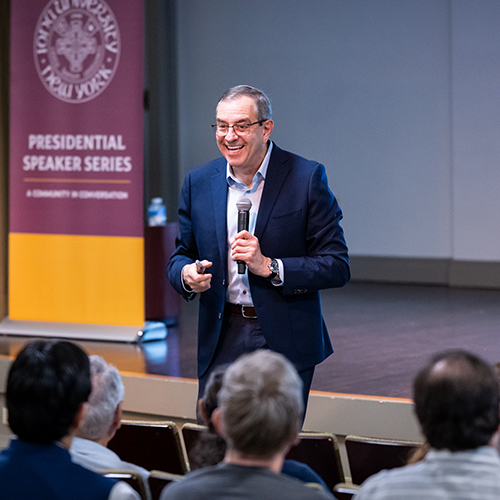
David Autor, Ph.D.
At Iona University’s “Future of Work: Finding Meaningful Careers in the AI Age” conference, hosted by the Gabelli Center for Teaching & Learning, faculty, students and business leaders gathered to examine how artificial intelligence is transforming the workplace and what that transformation means for education.
Setting the tone for the event was David Autor, Ph.D., one of the nation’s leading labor economists, who opened the conference with a keynote that challenged easy assumptions about artificial intelligence and job loss.
In his talk, “Expertise, Artificial Intelligence, and the Work of the Future,” the MIT professor argued that the real question is not simply whether a job is exposed to technology, but how that technology changes the expertise required to do the work.
“Expertise means domain-specific knowledge used to accomplish something of value,” Autor said. “It could be baking a loaf of bread, coding an app, diagnosing patients, remodeling a kitchen, and so on. Not all expertise is economically valuable. Two things are required for expertise to have economic value: it needs to be an input into something people want to pay for, and it needs to be scarce.”
His remarks gave the conference an intellectual framework for thinking about one of its central concerns: what meaningful work will look like in the age of AI.
Rather than presenting AI as a force that simply replaces people, Autor described a more human story. In his opinion, some jobs may become less specialized and more open to competition. Others may shed routine tasks and leave workers doing more expert, higher-value work.
“There’s such a thing as good exposure,” Autor said. “We all use tons of technologies. We’re not threatened by them.”

Autor provided an intellectual framework for understanding meaningful work in the age of AI.
That argument fit squarely within the conference’s broader theme. Intentionally designed to mirror Iona’s contributions to the AI moment, the event encouraged attendees to explore not only how AI is changing the workforce, but how colleges and universities can respond in ways that help students build meaningful careers. In that sense, Autor’s talk connected labor economics to the educational mission at the center of the gathering.
The keynote also struck a balance between realism and optimism. Autor acknowledged the disruption AI may bring, but he also urged the audience not to confuse early disruption with a final outcome.
“Many, many discoveries are ahead,” Autor said. “We’re in such an early stage of this, we have no idea if we will use this opportunity well yet.”
That message carried into the subsequent Q&A session, where audience members asked about globalization, career pathways, education and the continuing value of human judgment. Autor suggested that students entering a more automated economy will need more than technical fluency. They will need judgment, synthesis and the ability to think clearly in a noisy, complex information environment.
As the evening drew to its conclusion, Autor offered more than a warning about disruption. He had given the audience a framework for thinking about work itself — not as a fixed list of tasks waiting to be automated, but as a changing landscape shaped by expertise, institutions and human ingenuity.
“We should be looking for moonshots,” Autor said. “I think that’s where a lot of the opportunity will lie.”
ABOUT IONA
Founded in 1940, Iona University is a master's-granting private, Catholic, coeducational institution of learning in the tradition of the Edmund Rice Christian Brothers. Iona's 45-acre New Rochelle campus and 28-acre Bronxville campus are just 20 miles north of Midtown Manhattan. With a total enrollment of over 4,000 students and an alumni base of 55,000 around the world, Iona is a diverse community of learners and scholars dedicated to academic excellence and the values of justice, peace and service. Iona is highly accredited, offering undergraduate degrees in liberal arts, science and business administration, as well as Master of Arts, Master of Science and Master of Business Administration degrees and numerous advanced certificate programs. Iona students enjoy small class sizes, engaged professors and a wide array of academic programs across the School of Arts & Science; LaPenta School of Business; NewYork-Presbyterian Iona School of Nursing & Health Sciences; and Hynes Institute for Entrepreneurship & Innovation. Iona also continues to be recognized in prestigious national rankings. Most recently for 2026, Iona has been named one of the nation’s best colleges by The Princeton Review, The Wall Street Journal, Forbes and others. Additionally, U.S. News & World Report recognized Iona as one of top for social mobility in the country, while Georgetown University's Center on Education and the Workforce (CEW) ranked an Iona degree in the top 6 percent nationally for long-term return on investment. Iona’s LaPenta School of Business, meanwhile, is also accredited by AACSB International, a recognition awarded to just 6 percent of business schools worldwide. In addition, The Princeton Review once again named Iona to its “Best Business Schools for 2025,” recognizing both its on-campus and online MBA programs. Connecting to its Irish heritage, Iona also opened a new campus in County Mayo, Ireland, located on the historic 400-acre Westport House Estate. A school on the rise, Iona officially changed its status from College to University on July 1, 2022, reflecting the growth of its academic programs and the prestige of an Iona education.