AI-Aware Education Conference Draws Over 200 Educators to Iona University
Iona’s Gabelli Center for Teaching & Learning convenes K–12 and higher education leaders to examine teaching, learning and human connection in the age of artificial intelligence, including a keynote by author and educator Marc Watkins
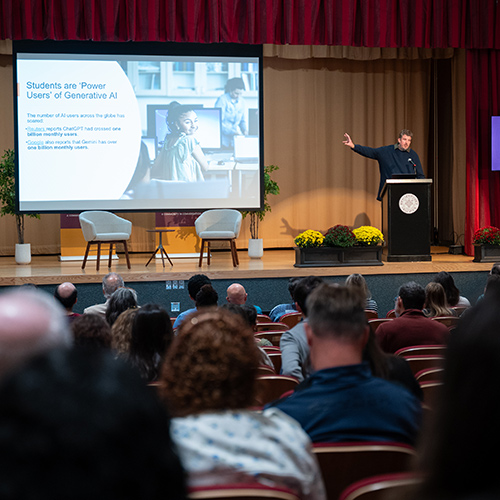
The conference built upon Iona’s sustained commitment to driving pedagogical innovation in the age of artificial intelligence.
NEW ROCHELLE, N.Y. — Over 200 educators from across the tri-state region recently gathered at Iona University for the Gabelli Center for Teaching & Learning’s Fall 2026 conference, “The Future of Teaching: Meeting the Challenge of AI-Aware Education.”
The second annual event underscored Iona’s growing leadership in advancing thoughtful, practical and human-centered approaches to artificial intelligence in education. Conversations explored AI awareness and responsible use; adolescent development and attention; the changing nature of classroom instruction; and the importance of preparing students for a rapidly evolving world of work.
Marc Watkins, a prominent national voice in the conversations about AI in education and co-author of the recently published “The Norton Guide to AI-Aware Teaching,” provided the keynote address. He also worked exclusively with Iona faculty prior to the conference, stating afterward, “I believe Iona is in a leadership position to host these critical conversations around AI and our human values.”
Keeping Humanity at the Center of AI in Education
How can educators embrace artificial intelligence without losing sight of what makes learning human? Iona University students, educators and guests explore how critical thinking, creativity, human connection and Catholic values can guide the thoughtful use of AI in education.
Leadership in the Age of AI
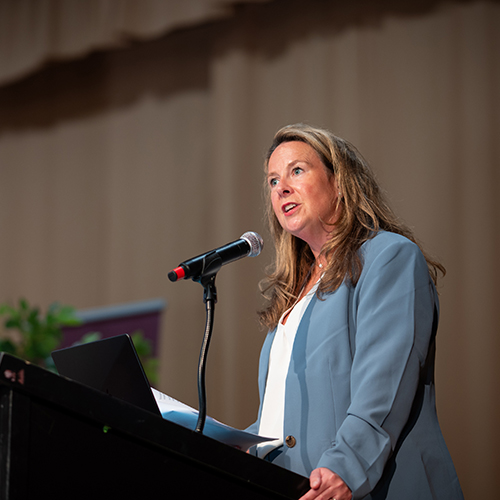
“The future of education will not simply happen to us—educators have an essential role in shaping it.” -Tricia Mulligan, Ph.D.
The conference builds upon Iona’s sustained commitment to driving pedagogical innovation in the age of artificial intelligence.
Through the Gabelli Center for Teaching & Learning, founded in April 2024, the University has invested in faculty fellowships and professional development; trained and collaborated with K–12 educators through the AI@Iona initiative; and hosted leading voices in AI, education, ethics and industry as part of its Presidential Speaker Series.
Rooted in the Catholic tradition, Iona's approach recognizes AI as a powerful tool while reaffirming that education ultimately requires something technology cannot replace: the development of curious, ethical and intellectually liberated human beings.
“As we heard throughout the conference, the takeaway is clear: In a world filled with increasingly fast answers, education must help students develop the courage, wisdom and discipline to pause and ask the most important questions,” said Tricia Mulligan, Ph.D., provost and senior vice president for Academic Affairs at Iona. “The future of education will not simply happen to us—educators have an essential role in shaping it.”
A ‘Duty of Care’
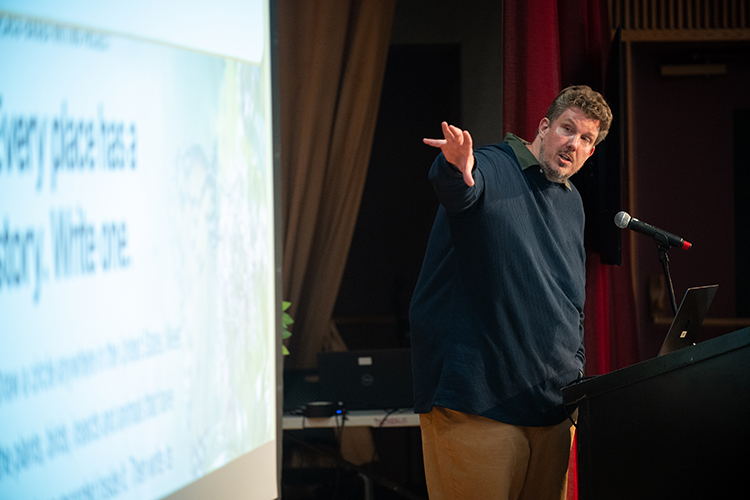
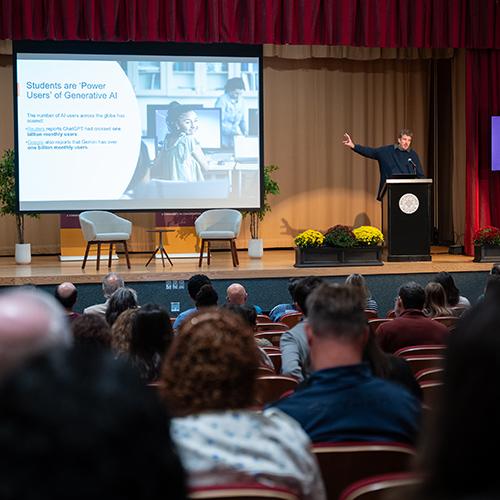
Keynote speaker Marc Watkins stressed the importance of orienting students to the demands and opportunities the AI world presents.
In his keynote, Watkins, founding director of the Mississippi AI Institute and assistant director of Academic Innovation at the University of Mississippi, anchored the conversation in the ‘duty of care’ educators have to their students—meaning, the responsibility to orient them to the demands and opportunities the AI world presents.
Exploring recent news articles, responsible AI applications, advanced use cases, and the need for trust between teachers and students, his talk offered a practical framework for determining when technology can enhance learning, as well as when productive friction may better serve students.
“A lot of people I’ve talked with feel like AI is happening to them, or that they don’t have agency or control. I hope they realize that their decisions matter right now,” said Watkins, who writes regularly about AI and education on his popular Substack, Rhetorica. “I think [Iona University] is doing a great job of having these types of actual, formal discussions, thinking about where AI fits in this space. A lot of larger, massive universities aren’t able to do this.”
Understanding Today’s Student
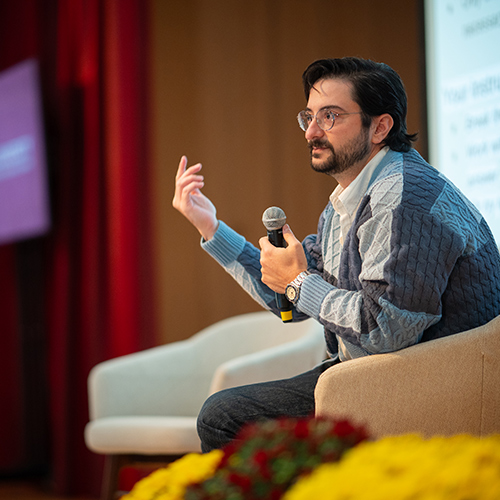
Eric Abrams, Ph.D., led the session “Fixing What Chatbots Broke.”
The conference also broadened the conversation beyond AI itself, examining the developmental and cultural changes influencing how students learn.
Christy Solorio, Ph.D., MS, RN, CNE, CPN, assistant professor of nursing, and Allyson Compton, Ph.D., assistant professor of education, explored shifts in traditional-age college students, including changes in attention patterns, developmental needs and expectations surrounding academic work. Their session considered why instructional strategies that may once have been effective do not always resonate with today’s students and offered practical approaches for adapting instruction while maintaining meaningful academic expectations.
Eric Abrams, Ph.D., senior director of clinical experiences and clinical lecturer of education, led the session “Fixing What Chatbots Broke.” Abrams invited educators to consider the broader influence and evolution of educational technology, while also challenging the audience to test—and break—the boundaries of an AI chatbot.
“I hope participants walk away with some great questions to ask—not only of their students, but of themselves and their teaching practices,” Abrams said. “I hope they get inspired to look at the underlying systems and try to imagine what this can look like in a new paradigm, and ask, how can we make teaching and learning better? Because it always has to get better. I think once you think that you’re a great teacher, maybe it’s time to walk away—because you can always get better and adapt, change and progress your practices.”
A New Model
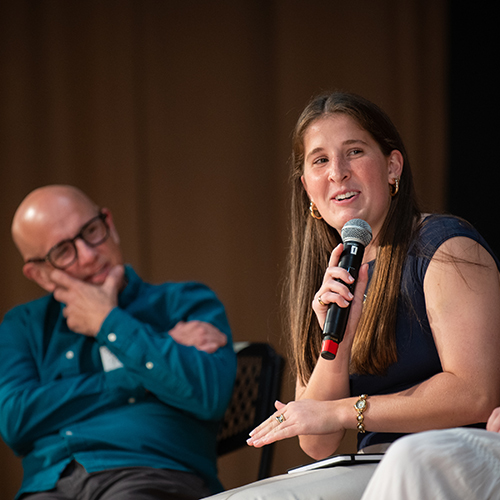
“I feel like I’m at the forefront of all of this, and I think it’s really important for students to be a part of it.” -Chloe Marblestone, Class of 2028
The conference culminated with a student- and faculty-led panel exploring Iona’s pioneering pilot program, Education in Real Life (EIRL). Launched this past summer, EIRL is an experiment in teaching and learning designed to bridge the traditional divide between the world of study and the world of work.
Through collaboration with partners in three critical industries—energy (Eos Energy Enterprises); construction (Consigli Construction Co., Inc.); and hospitality (Union Square Hospitality Group, Wyndham Hotels and Resorts and legendary Westchester restaurateur John Crabtree)—and an engagement with emerging technologies, the initiative reconsidered conventional classroom practices and challenged both students and teachers to navigate this moment of uncertainty with curiosity and confidence.
Faculty leaders Rob Kissner, MBA, clinical lecturer in the Hynes Institute for Entrepreneurship & Innovation; Dean DeFino, Ph.D., professor of English and director of Film Studies; and Ivy Linton Stabell, Ph.D., associate professor of English; were joined by Iona students to reflect on what the initiative revealed about the future of education.
Importantly, the student panel ensured that the voices of learners themselves remained central to a conference devoted to the future of teaching, as they were central to the unfolding of EIRL itself.
“This is such a rapidly changing environment and being part of the conversation has really been motivating for me,” said Chloe Marblestone '28, a media and communication major. “Being a student that gets to be included has been super rewarding; I really like offering my perspective and also just getting the opportunity to learn and inspire myself. I feel like I’m at the forefront of all of this, and I think it’s really important for students to be a part of it. So to be one of them has meant a lot to me.”
A Community in Conversation
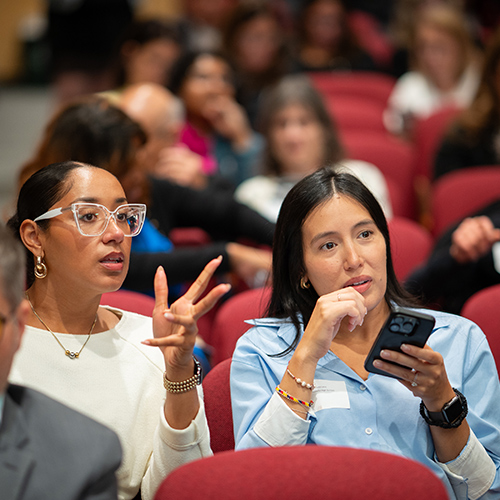
Over 200 educators from across the tri-state region were in attendance.
The breadth of participation was a defining feature of the conference. With educators spanning K–12 public, private and Catholic schools as well as higher education, the gathering created opportunities for educators who may approach AI from different institutional contexts to learn from one another and bring back important learnings.
June Gondi, of The Shipley School in Bryn Mawr, Pa., attended last year’s inaugural conference and returned again this year to continue the conversation. She said she appreciated the spirit of collaboration throughout the conference.
“AI has transformed the way we engage with information and I felt that I needed to be in a place where people were having open conversations about it, talking about the hard things—our fears, our hopes and just our wonderings. Like I tell my students, ‘What are you wondering about?’” she said with a laugh. “AI has been adopted in every sphere of our lives, whether we are aware of it or not. So, we need to understand what's going on—how it's reshaping things and what potential it might have to impact the way our students engage with their worlds outside of school. We need to be more cognizant and aware of the world we are preparing them for.”
Robert York, assistant principal at Kellenberg Memorial in Uniondale, N.Y., echoed that sentiment, saying that as educators, it is critical that they continue to be knowledgeable about both the challenges and opportunities presented by AI in order to help guide their students through this paradigm-shifting moment.
“Challenges exist everywhere... We have to be the human element in this equation,” he said. “I will take a great deal back with me from today. There were really great presentations and there was a real good spirit in what they were presenting. But also, there wasn’t in any way a sense that we couldn't accomplish something great together. So we felt like we can walk away confident going back to our classrooms.”
Christina Reidel, an eighth-grade U.S. history teacher in Bronxville, said she really appreciated hearing from all the presenters, as together, they are helping to develop a common language that is critical at this time.
“I think the thing that really stands out to me is that they’re helping me as an educator have a language to talk about AI and help to understand how it could best be deployed in my classroom,” she said. “I think there’s a lot of concern [about AI], but I think for a lot of parents in particular, they’re also engaging with it on a daily basis. So they’re wondering how, as teachers, we're helping their kids and preserving their formative cognitive development while at the same time giving them some limited and very guided direction in the application. And that’s what I'm trying to do.”
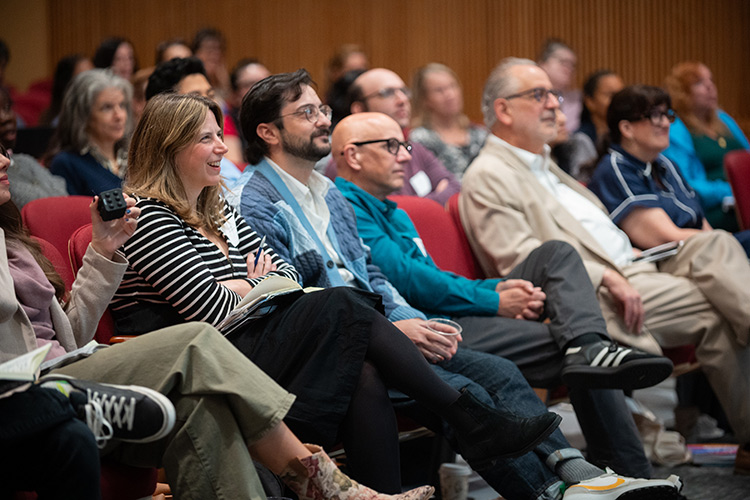
With educators spanning K–12 public, private and Catholic schools as well as higher education, attendees gained valuable perspectives from each other on the role AI plays in the classroom.
Kathleen McGreal, a Scarsdale High School English teacher, attended the inaugural conference and returned this year with several colleagues. As both an educator and the parent of a current Iona student, she has been following the developments closely.
“What I really love about the message and what Iona is doing—first of all, to be at the forefront of this work and asking these difficult questions—but also putting it into the ethos of Catholic education and the spirit of the person. Because I do think what the beautiful thing is, is to be reminded of the soul and the heart and the intellect of the person being the most important. And while AI might become a tool, it doesn't necessarily have to dominate the good learning that our students do,” McGreal said. “We are just really interested in deepening the conversation and exploring these questions of what it means to be human in this world of artificial intelligence.”
ABOUT IONA
Founded in 1940, Iona University is a master's-granting private, Catholic, coeducational institution of learning in the tradition of the Edmund Rice Christian Brothers. Iona's 45-acre New Rochelle campus and 28-acre Bronxville campus are just 20 miles north of Midtown Manhattan. With a total enrollment of over 4,000 students and an alumni base of 55,000 around the world, Iona is a diverse community of learners and scholars dedicated to academic excellence and the values of justice, peace and service. Iona is highly accredited, offering undergraduate degrees in liberal arts, science and business administration, as well as Master of Arts, Master of Science and Master of Business Administration degrees and numerous advanced certificate programs. Iona students enjoy small class sizes, engaged professors and a wide array of academic programs across the School of Arts & Science; LaPenta School of Business; NewYork-Presbyterian Iona School of Nursing & Health Sciences; and Hynes Institute for Entrepreneurship & Innovation. Iona also continues to be recognized in prestigious national rankings. Most recently for 2026, Iona has been named one of the nation’s best colleges by The Princeton Review, The Wall Street Journal, Forbes and others. Additionally, U.S. News & World Report recognized Iona as one of top for social mobility in the country, while Georgetown University's Center on Education and the Workforce (CEW) ranked an Iona degree in the top 6 percent nationally for long-term return on investment. Iona’s LaPenta School of Business, meanwhile, is also accredited by AACSB International, a recognition awarded to just 6 percent of business schools worldwide. In addition, The Princeton Review once again named Iona to its “Best Business Schools for 2025,” recognizing both its on-campus and online MBA programs. Connecting to its Irish heritage, Iona also opened a new campus in County Mayo, Ireland, located on the historic 400-acre Westport House Estate. A school on the rise, Iona officially changed its status from College to University on July 1, 2022, reflecting the growth of its academic programs and the prestige of an Iona education.