

Iona University Launches “Attention Passport” to Help Students Reclaim Their Focus
New initiative encourages students to practice attention activism as Iona explores the evolving role of AI, technology and distinct human habits in education

Iona’s Attention Passport challenges students to build more intentional learning habits.
NEW ROCHELLE, N.Y. — As artificial intelligence becomes increasingly embedded in how students learn, Iona University is focusing on something technology is making increasingly difficult to hold onto: attention.
This fall, Iona is introducing the “Attention Passport,” a new initiative sponsored by the Gabelli Center for Teaching & Learning that is designed to encourage students to practice different forms of attention and reflect on where they choose to direct their focus.
Much like a traditional travel passport, the physical passport gives students a place to collect stamps representing experiences throughout the academic year. Students can earn stamps by participating in designated campus activities — ranging from lectures and reflection to service projects and conversations — as well as through independent practices such as uninterrupted reading or taking a phone-free walk.
There is no finish line and no required number of stamps. Instead, the goal is for students to build a personal record of moments they deliberately choose to give something their undivided attention.
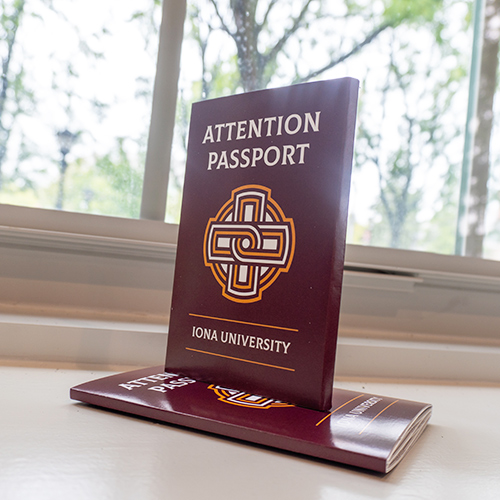
This new initiative turns everyday moments of attention into meaningful progress.
For students, the effort also means recognizing the forces competing for their attention every day. Selah Chambers ’30 sees attention awareness as a response to an environment where focus itself has become increasingly valuable.
“In an attention economy where our focus is bought, sold and monetized, attention activism is essential,” Chambers said. “Attention passports give students a tangible incentive to reclaim their focus through mindfulness.”
The passport builds upon a growing university-wide conversation around attention, technology and learning. Over the past year, Iona has worked with author and Princeton scholar D. Graham Burnett, Ph.D., and the Strother School of Radical Attention (SoRA) to introduce students and faculty to the concept of “attention activism,” the practice of protecting and directing one’s attention in a world increasingly designed to capture it.
Burnett challenged the Iona community to consider what he calls “attention fracking,” the constant extraction and monetization of human attention by digital platforms and technologies. The SoRA team will be facilitating attention labs and workshops at Iona through the fall semester.
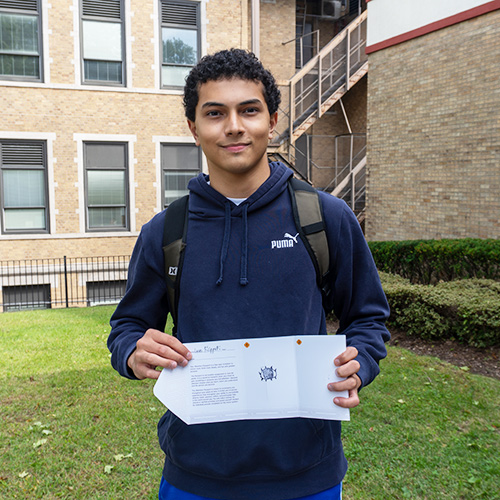
Students earn stamps by participating in experiences that encourage reflection and deeper engagement.
That work has taken on new urgency as generative AI continues to challenge long-standing assumptions about higher education.
Rather than viewing the conversations around AI and attention as competing priorities, Iona is exploring them together: examining where emerging technology can strengthen teaching and learning while asking which distinctly human habits students will need to cultivate as technology becomes even more ubiquitous.
The passport project was imagined this summer by a group of Iona faculty who have shaped its implementation with freshman students.
“I am thrilled that we have chosen to do more than simply recognize, or worse, just complain about, the growing difficulty of sustaining attention,” Iona Honors Program Director Dan Thiery said. “We all face a digital world increasingly designed to capture and monetize our attention. The Passport won't solve this problem on its own, but it represents a meaningful and imaginative step toward heightened awareness. My hope is that, after four years of practicing and reflecting on attention, our students will leave Iona a little wiser in asking themselves one fundamental question: ‘What truly deserves my attention?’”

The Attention Passport encourages students to rethink their relationship with technology and reclaim their attention.
The Attention Passport turns that conversation into something students can practice in their everyday lives — without prescribing what that practice has to look like.
“The attention passport is necessary, but not in the traditional sense. It’s entirely up to you whether you make use of it or not,” said Lucas Baptista ’30. “It’s definitely going to help the students who choose to embrace it; if nothing else, it’s a great physical reminder to be present in all aspects of your life.”
Iona’s Gabelli Center will be sponsoring a spring conference on “The Attention Imperative” on April 30, 2027. The conference will be open to all educators and the general public.
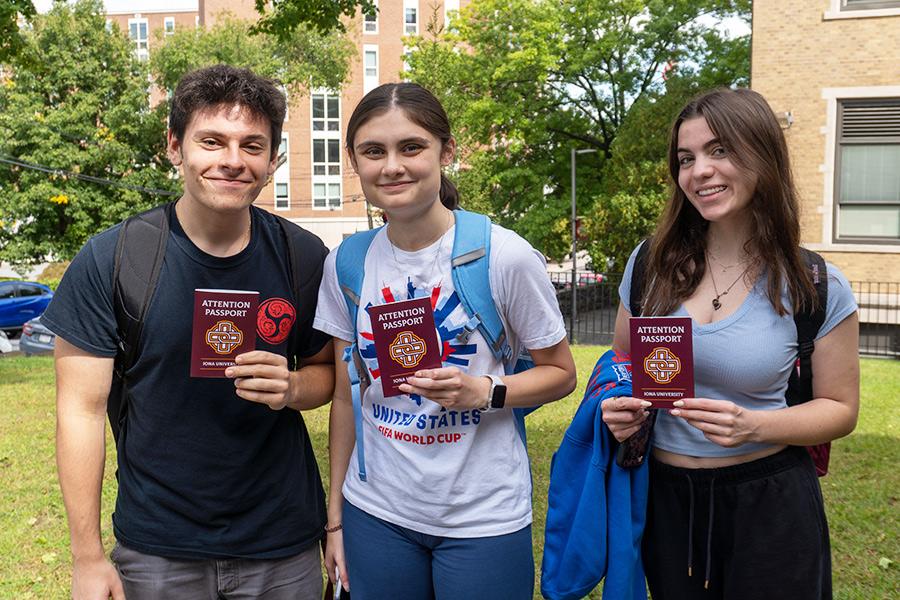
Iona students embrace a campus-wide challenge to build stronger habits of attention and connection.
ABOUT IONA
Founded in 1940, Iona University is a master's-granting private, Catholic, coeducational institution of learning in the tradition of the Edmund Rice Christian Brothers. Iona's 45-acre New Rochelle campus and 28-acre Bronxville campus are just 20 miles north of Midtown Manhattan. With a total enrollment of over 4,000 students and an alumni base of 55,000 around the world, Iona is a diverse community of learners and scholars dedicated to academic excellence and the values of justice, peace and service. Iona is highly accredited, offering undergraduate degrees in liberal arts, science and business administration, as well as Master of Arts, Master of Science and Master of Business Administration degrees and numerous advanced certificate programs. Iona students enjoy small class sizes, engaged professors and a wide array of academic programs across the School of Arts & Science; LaPenta School of Business; NewYork-Presbyterian Iona School of Nursing & Health Sciences; and Hynes Institute for Entrepreneurship & Innovation. Iona also continues to be recognized in prestigious national rankings. Most recently for 2026, Iona has been named one of the nation’s best colleges by The Princeton Review, The Wall Street Journal, Forbes and others. Additionally, U.S. News & World Report recognized Iona as one of top for social mobility in the country, while Georgetown University's Center on Education and the Workforce (CEW) ranked an Iona degree in the top 6 percent nationally for long-term return on investment. Iona’s LaPenta School of Business, meanwhile, is also accredited by AACSB International, a recognition awarded to just 6 percent of business schools worldwide. In addition, The Princeton Review once again named Iona to its “Best Business Schools for 2025,” recognizing both its on-campus and online MBA programs. Connecting to its Irish heritage, Iona also opened a new campus in County Mayo, Ireland, located on the historic 400-acre Westport House Estate. A school on the rise, Iona officially changed its status from College to University on July 1, 2022, reflecting the growth of its academic programs and the prestige of an Iona education.