
Exploring AI’s Role in the Classroom: Iona’s Aakash Sapru Speaks with The Bronxville School on Embracing Roles as ‘Choice Architects’ in the Age of AI
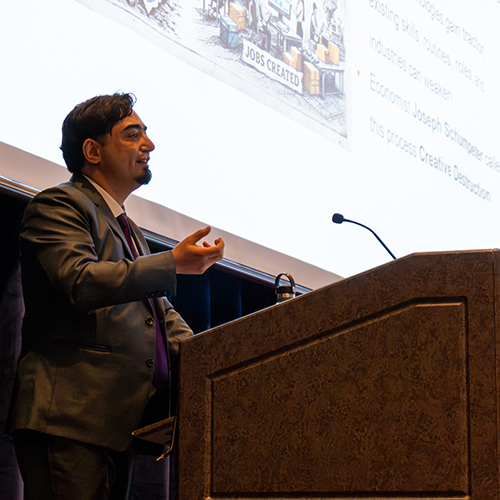
Dr. Aakash Sapru discussed the concept of "creative destruction" and the evolution of professional roles in the age of AI.
At The Bronxville School’s Superintendent’s Day on Friday, March 20, Hynes Institute for Entrepreneurship and Innovation Assistant Professor Aakash Sapru, Ph.D., invited school faculty and staff to think critically about artificial intelligence not as a force that simply happens to education, but as a tool whose impact depends on the choices educators make.
In his presentation, “Educators as Stewards of Human Thought: Redesigning Student-Centered Learning with AI,” Sapru framed educators as “choice architects” with both the power and the responsibility to determine how AI is integrated into their work and learning environments.
Speaking to Bronxville School faculty and staff, Sapru emphasized that major innovations do more than introduce new tools; they also reshape existing ways of working and learning. Positioning AI within that broader context, he encouraged attendees to move beyond viewing artificial intelligence as a single, one-dimensional concept and instead consider the different forms it can take, from generative AI to predictive AI, each with its own opportunities, risks and educational implications.

Audience members discussed classroom innovation in regards to AI.
Central to Sapru’s message was the idea that educators are already designing the conditions in which students learn. From classroom activities to homework and assessment design, he noted that every instructional decision helps shape how students engage with course material, with one another and with AI itself. Rather than beginning with the question, “Can AI do this?” Sapru urged educators to start with a more important one: “What is in the student’s best interest to develop here?” That student-centered approach, he argued, should remain the guiding principle in any conversation about AI in education.
“It was a privilege to speak with the outstanding educators at The Bronxville School about the role of AI in teaching and learning,” Sapru said. “As educators and professionals, we all have the opportunity to serve as ‘choice architects.’ I am excited by the possibilities AI presents in education, especially when its use is guided with intention, responsibility, and a clear focus on what is in students’ best interests.”
Sapru also encouraged faculty and staff to reflect on their own attitudes toward AI, noting that both enthusiasm and skepticism can influence how these tools are introduced and discussed in educational settings. Thoughtful innovation, he suggested, requires not only experimentation — but also reflection, collaboration, and a willingness to engage concerns without allowing them to shut down curiosity or progress.
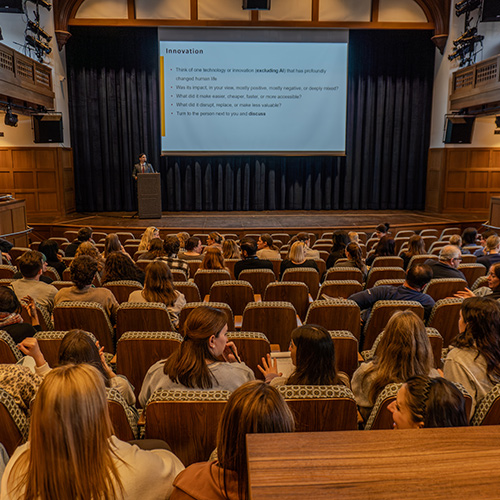
Dr. Aakash Sapru lead a discussion on the role of AI in education during The Bronxville School’s Superintendent’s Day.
Closing in the spirit of partnership and shared purpose, Sapru underscored his central message: every individual has the power — and the responsibility — to act as a “choice architect.” For educators, that means helping shape how (or whether) AI is introduced into students’ daily lives in ways that prepare them to move through their academic and professional journeys with confidence.
"Dr. Sapru’s keynote at our Superintendent's Conference Day provided guidance in how to navigate the 'creative destruction' of AI by placing educators in the role of 'choice architects',” Bronxville School Assistant Superintendent of Curriculum and Instruction Ann Meyer said. “His framework focused on a student-centered approach that prioritizes cognitive, emotional, and social development. He tasked teachers with always asking themselves what serves the student's best interest. Dr. Sapru has given us a clear roadmap for responsible, thoughtful innovation in our classrooms."
The visit built upon Iona’s ongoing AI@Iona partnership with the Bronxville School, where Iona faculty have engaged K-12 educators in multi-session workshops throughout the school year, made possible through the Gabelli Center for Teaching & Learning. To learn more or get involved, contact provost@iona.edu.
ABOUT IONA
Founded in 1940, Iona University is a master's-granting private, Catholic, coeducational institution of learning in the tradition of the Edmund Rice Christian Brothers. Iona's 45-acre New Rochelle campus and 28-acre Bronxville campus are just 20 miles north of Midtown Manhattan. With a total enrollment of over 4,000 students and an alumni base of 55,000 around the world, Iona is a diverse community of learners and scholars dedicated to academic excellence and the values of justice, peace and service. Iona is highly accredited, offering undergraduate degrees in liberal arts, science and business administration, as well as Master of Arts, Master of Science and Master of Business Administration degrees and numerous advanced certificate programs. Iona students enjoy small class sizes, engaged professors and a wide array of academic programs across the School of Arts & Science; LaPenta School of Business; NewYork-Presbyterian Iona School of Nursing & Health Sciences; and Hynes Institute for Entrepreneurship & Innovation. Iona also continues to be recognized in prestigious national rankings. Most recently for 2026, Iona has been named one of the nation’s best colleges by The Princeton Review, The Wall Street Journal, Forbes and others. Additionally, U.S. News & World Report recognized Iona as one of top for social mobility in the country, while Georgetown University's Center on Education and the Workforce (CEW) ranked an Iona degree in the top 6 percent nationally for long-term return on investment. Iona’s LaPenta School of Business, meanwhile, is also accredited by AACSB International, a recognition awarded to just 6 percent of business schools worldwide. In addition, The Princeton Review once again named Iona to its “Best Business Schools for 2025,” recognizing both its on-campus and online MBA programs. Connecting to its Irish heritage, Iona also opened a new campus in County Mayo, Ireland, located on the historic 400-acre Westport House Estate. A school on the rise, Iona officially changed its status from College to University on July 1, 2022, reflecting the growth of its academic programs and the prestige of an Iona education.